
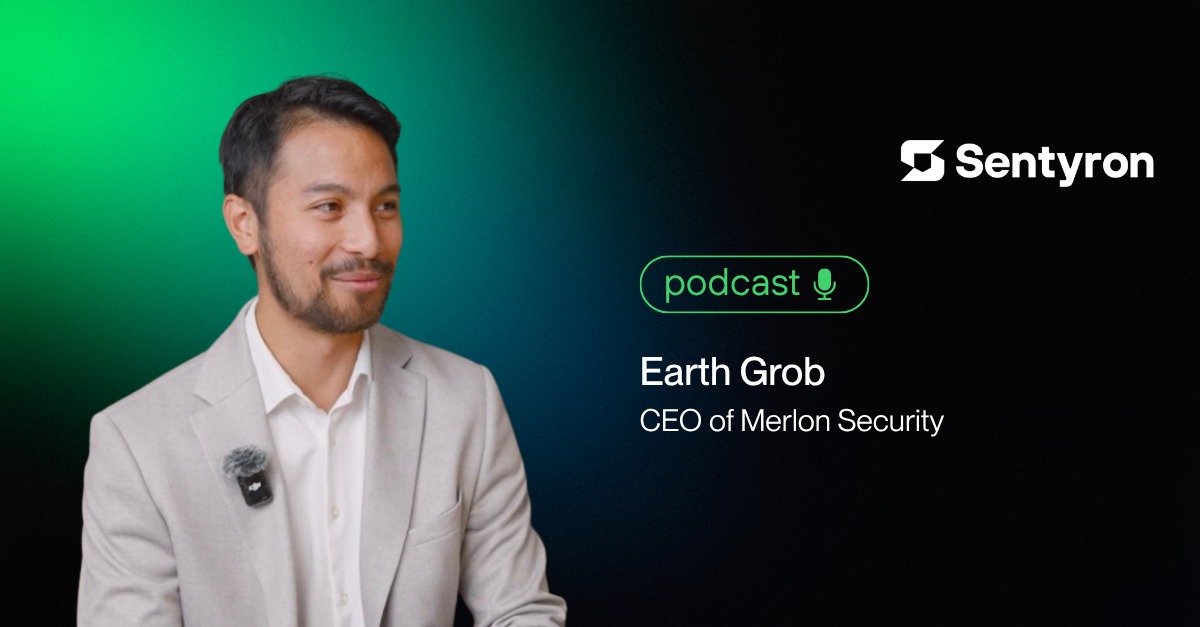
Earth Grob, CEO of Merlon Security, runs a cybersecurity company with one simple purchasing rule: “No invoice reaches us from outside Europe.” That rule covers far more than software. It applies to the cars his team drives, the fonts on the company website and, half-jokingly, the peanut butter on the office table. In the latest episode of The Sentyron Standard, Earth explains why he went all in, and why he doesn’t expect every organisation to do the same.
From preference to necessity
Merlon Security’s European tech stack grew gradually. Pricing models and restrictions from big tech vendors eroded trust, so the team kept choosing European suppliers they could actually talk to. The real tipping point came from their customers. Much of Merlon’s work is for suppliers to the defence industry, and a growing share of the end users operate in Ukraine.
“I don’t have to explain to them why sovereignty matters. They come to us asking for it,” says Earth. For those organisations, the question isn’t ideological. “If there’s downtime, people die. That’s not a risk we’re willing to take. We need technology we can rely on.”
Earth deliberately avoids the vague definitions. For him, digital autonomy means working with suppliers in countries with the same legislation and the ability to hold them accountable. “If I wanted to take Microsoft to court, I’d have to go to Washington DC and start a war with their army of lawyers. That’s not a fair playing field.” Even Switzerland is now being phased out of Merlon’s stack. His verdict on the market: “Sovereignty has become a sticker people slap on things.”
A spectrum, not a switch
Internally, Merlon flipped the switch overnight. That’s easier when eighteen of your twenty employees are engineers who don’t mind a bit of pain. Earth is candid about the trade-offs: the team dropped its American AI provider, and the European models they tried are not yet at the same level.
For customers, he takes a different approach. “Sovereignty is a spectrum.” Large organisations don’t run on sovereignty, they run on whatever their core business is, so Merlon advises a risk-based route: move step by step, for instance along the SEAL levels from zero to four. “You don’t want people to develop an aversion to the whole concept because it feels like a nuisance, while they actually support the mission.”
The biggest dependency, according to Earth, is hardware. Yet even there, progress is possible. Merlon’s laptops are assembled in Haaksbergen, with European RAM and boot software from Poland. The Intel chip remains the weak spot, so the Intel Management Engine is disabled and alternatives are being researched. The reaction from customers surprised him: “They’re the first to say: call me when it works, I’ll order them right away.”
That demand also tackles two persistent myths. Is European tech more expensive? “That misconception can go straight in the bin. Apple is expensive anyway.” Is it worse? Not in Merlon’s experience. “Americans are better at selling their tech and invest more in user experience. We Europeans tend to say: the CLI works fine, doesn’t it?”
Procurement lags behind
Frameworks such as ABRO and CMMC set clear requirements for cryptography and secure communication. That is why Merlon implements Sentyron’s solutions for its customers and recently became a partner. But in most tenders, sovereignty is still missing. “What we hear is: it isn’t in the tender, but if sovereign is possible, that would be great.” Earth doesn’t see unwillingness, but processes that haven’t caught up. “Technology moves faster than the procedures and policies written around it.”
Innovation, he believes, needs room to fail. Every Friday, Merlon’s engineers get time to research whatever they like, as long as it’s not client work. One of those experiments became Merlon’s threat intelligence portal, now a commercial product. Another is investigating whether a European alternative to British and American satellite phones is feasible. “Cybersecurity often comes across as fear-mongering. I miss the urge to tinker with things.”
Where Europe should be in five years
Looking ahead, Earth sees the mass adoption of AI by attackers as the defining development, with agentic attacks and voice phishing at scale making attacks cheaper and more frequent. His hope for Europe is an industry it can be proud of, one that keeps founders here instead of losing them to American funding. Merlon has even written that ambition into its articles of association. He sees the irony in his own role, too. “I’m Thai, I moved from Thailand to the Netherlands, and now I’m the one convincing Europeans that they can do this.”