
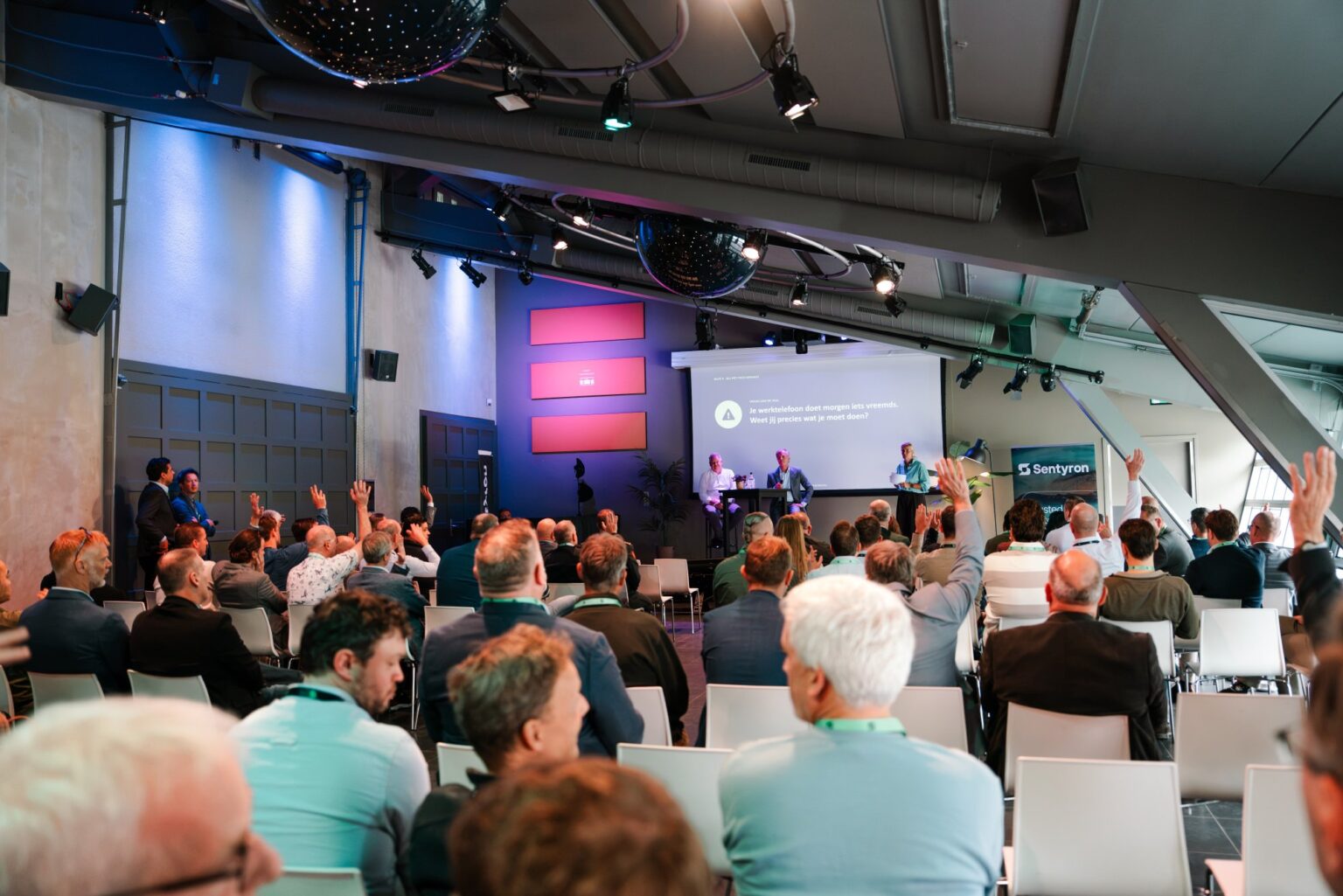
On 29 October, professionals from government, Defence and critical sectors came together at Fort Voordorp in Groenekan for the Sentyron Relationship Day. The theme: The New Line of Defence: Secure Communications in an Uncertain World. With keynotes from Bert Hubert, Colonel Mietta Groeneveld, Dave Maasland, Dennis Brocker and Carlo Verhagen, in-depth breakout sessions and a Product Experience Market, it was a day of vision, depth and connection.
The location turned out to be a fitting metaphor. Fort Voordorp is part of the New Dutch Waterline, a line of defence you could see. The day showed that today's line of defence is invisible. "It doesn't run along a fort, but through our daily work, right into our pockets," says Willemijn Rodenburg, host of the day. Here are the key insights from the day.

1. The threat has become quieter, and closer
Colonel Mietta Groeneveld showed that command and control has long stopped being only about physical means. Anyone still looking at conflict in the traditional way is not prepared. Adversaries combine influence, disruption, and kinetic means to achieve their goals.

Dave Maasland built seamlessly on that. We still focus too much on large, visible incidents, while it is precisely the small pinpricks that together form a campaign. The goal is not to take down a single system, but to sow doubt and undermine trust. That calls for a different way of looking, as Willemijn Rodenburg summarises: "We don't see the campaign because we're counting incidents. Our security is designed around reporting, resolving and closing. But when the adversary works with small pinpricks, nobody connects the dots."
2. Waiting is also a choice
When it comes to quantum computing, many organisations still think: that's something for later. The threat starts now: an adversary can intercept and store encrypted data today, to decrypt it later. Information you send now may still be sensitive in ten years' time. The good news is that you can already take measures today against that attack of the future.
The same applies to digital sovereignty. "The choice for sovereignty starts now," says Jeff Collée, Team Lead Sales Team at Sentyron. Geopolitical relations can shift quickly, and organisations that only then start thinking about control over their own data will be too late. In the end, it comes down to weighing the convenience of a familiar environment against the importance of sovereignty, and in these times that balance increasingly tips towards sovereignty.
3. Europe can do more than we think
The debate on sovereignty often focuses on dependencies and what can't be done. Bert Hubert turned that around and called on the audience to be prouder of what is already happening in Europe. At the same time, he warned that the reach of the United States extends further than we often realise. Pride and realism need to go hand in hand.
Carlo Verhagen built on this with a call for a national crypto industry on a sovereign foundation, and for the recognition that we can't do it alone.

4. The front line is in our pocket
One of the most confronting moments of the day was a simple show of hands. Most of the room, full of security professionals, carried at least two phones and also used their work phone for personal purposes. We consider device management on a laptop normal, but on a phone the same thing quickly feels like an intrusion on employee privacy.
That tension can't be solved with technology alone. The phone has become a fully fledged workplace, and that calls for agreements between employer and employee. Mobile security is therefore as much a matter for HR and culture as it is for IT.
5. Technology that isn't used protects no one
User adoption, compatibility and ease of use came up in almost every session. Not as a concession to security, but as a precondition for it. "We're past the phase where complexity equalled security," says Artie Debidien, COO of Sentyron. "The real challenge is simplicity without compromising on functionality or protection."
The same goes for the chain as a whole. There is no secure component in an insecure chain. Anyone serious about digital sovereignty therefore secures the entire stack: hardware, software and the way people work with it.
6. Stop the talking, start the walking
Collaboration was the common thread of the day, both among the speakers and in visitor feedback. But collaboration that actually leads somewhere. Ecosystems and networking events are valuable, but often too large and too non-committal to act quickly. Artie therefore calls for a coalition of the willing: "small, closed groups cutting across government, critical sectors and business that dare to decide and to act."
According to him, the problem isn't disagreement. When government representatives responded to Dave Maasland during the day with "we agree with you", it captured exactly where things get stuck. "The problem isn't that we disagree. The problem is that we've been agreeing for years."
Look at the pattern, start today and build together
The New Dutch Waterline only worked when forts, locks and people acted together. The same applies to today's line of defence. In the words of Willemijn Rodenburg: "The threat has become quieter and has come closer. If you only watch for the big blows, you miss the campaign. And if you wait for tomorrow's attack, you're too late. So look at the pattern, start today and build together. Europe can do more than we think, as long as we're not naive."
We would like to thank all speakers, visitors, and colleagues who made this day possible. See you next year!
