
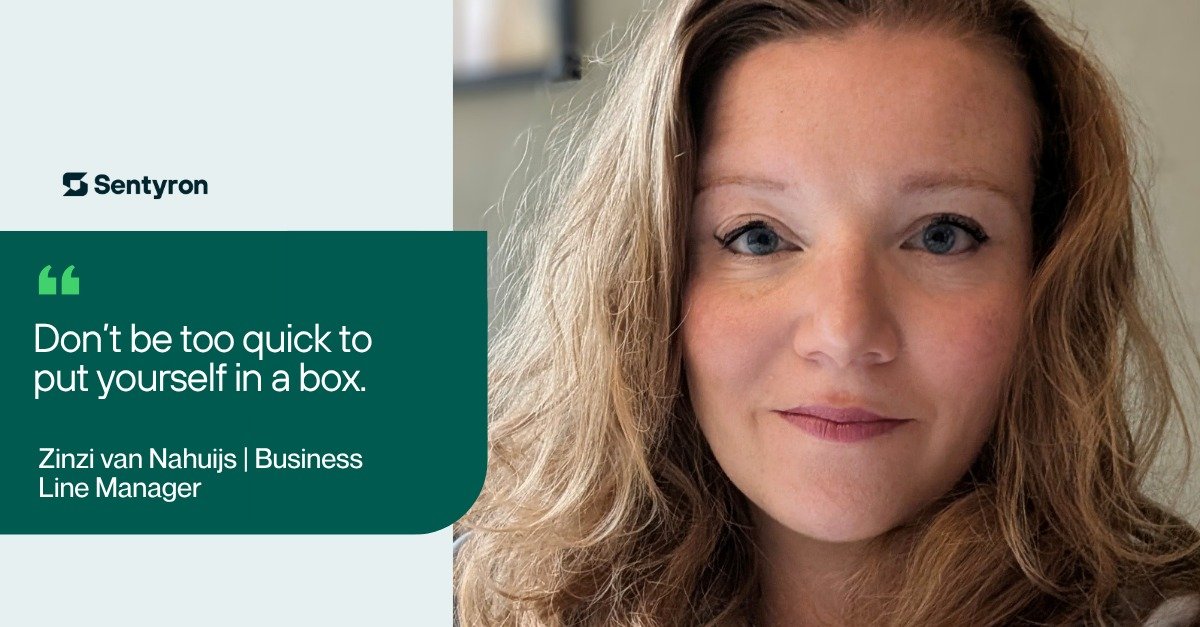
In this edition of Women in Cyber, we speak with Zinzi van Nahuijs, Business Line Manager Secure Information Transfer at Sentyron. She studied social sciences, planned a career in organisational change management and never pictured herself in cybersecurity. Today she works on some of the highest-assurance projects in the field, and the background she once thought was unrelated turns out to be one of her biggest strengths.
From sociology to security
Asked what she would tell her younger self, Zinzi doesn’t hesitate: “I would tell my younger self not to rule out cybersecurity so quickly!”
Her original interest lay elsewhere. She was fascinated by social systems, by how organisations work and how people interact, and her ambition was to work in organisational change management rather than anything technical. It was through IT consulting that she unexpectedly discovered cybersecurity, and developed a genuine passion for it.
What surprised her most was how closely the field connected to everything she had always cared about. “Cybersecurity is not just about technology. It is about people, organisations, society and the systems we depend on. In today’s digital world, it underpins almost everything and is fundamental to keeping our society running.”
Her advice follows naturally from that: “Don’t be too quick to put yourself in a box. You might discover that the things you are passionate about can take you somewhere you never expected. And that your seemingly unrelated background is actually one of your greatest strengths.” With a smile, she adds that walking into a high-security environment with “Authorized Personnel Only” printed on the door is pretty cool too.
What high assurance really means
One experience in particular changed how Zinzi looks at her work: supervising her first EAL 7+ certification project. “It gave me a completely different appreciation of what high assurance actually means. We were looking at hardware designs down to the individual components. Where do they come from? How do you demonstrate that they haven’t been tampered with? How do you establish a chain of trust that allows you to provide the highest possible level of assurance to your customers?”
What struck her was how directly that technical world is tied to events outside it. Geopolitical developments can make certain components harder to source, while at the same time driving up demand for the very products Sentyron works on. “Things you hear about in the news suddenly become very tangible when you see how directly they affect your work.”
The biggest realisation was a personal one: Zinzi had always wanted to do something meaningful, something that contributes to society, and didn’t necessarily expect to find that in cybersecurity. “We’re contributing to the trustworthiness of technology and systems that really matter. It’s not just an interesting technical field. It’s a field where you can make a genuine contribution to something much bigger than yourself.”
Security is a people issue
Recent cyber incidents, including the attacks on supermarkets, have made it clear to a wider audience that cybersecurity affects everyone and can no longer be treated as purely an IT responsibility. Yet according to Zinzi, one aspect is still underestimated: people and organisational culture.
“You can have the most sophisticated technical solutions in place, but they can only be effective if people understand their role in keeping an organisation secure.” Building a strong security culture means creating awareness and making security-conscious behaviour part of everyday working life.
Sometimes that means questioning habits that are perfectly natural elsewhere. Holding the door open for the person behind you is normally just polite, but in a security-sensitive environment you may need to think twice about whether that person should actually have access.
For Zinzi, that is where both the challenge and the opportunity lie: “Making security something people understand, embrace and take ownership of. Not because they have to follow a set of rules, but because they understand why it matters.”