
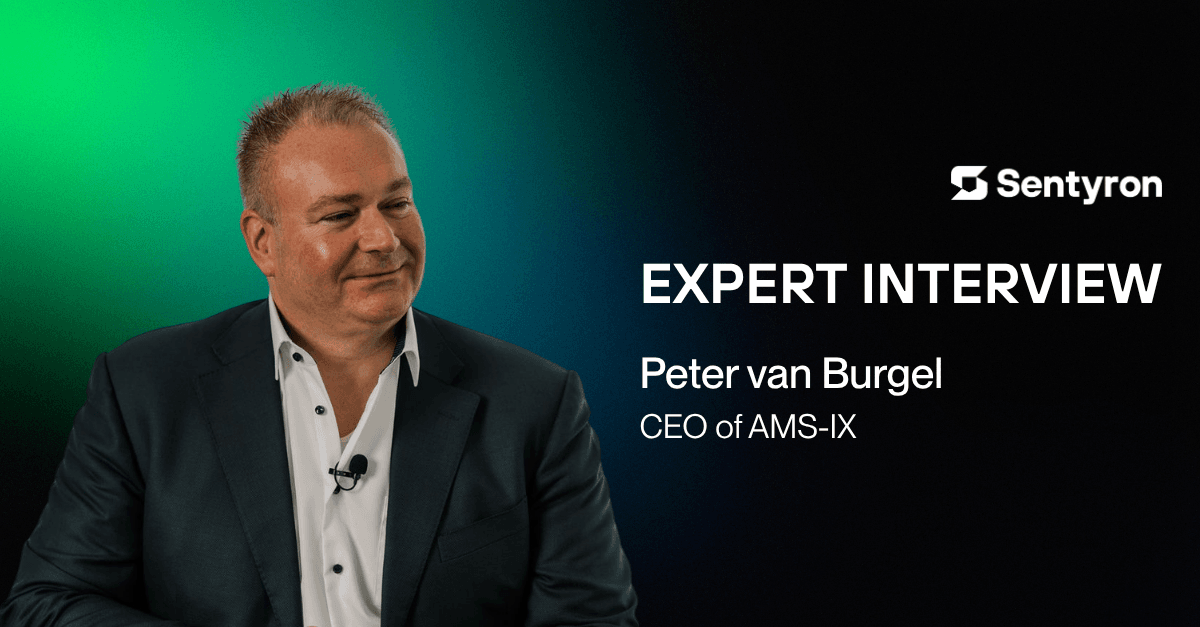
In this episode of The Sentyron Standard, Willemijn Rodenburg speaks with Peter van Burgel, CEO of AMS-IX, one of the world’s largest internet exchanges. From Amsterdam, AMS-IX helps route the traffic that keeps networks, cloud providers, telecoms and platforms connected. Most people never see that layer of the internet. But they depend on it every day. That is what makes this conversation urgent. Peter is not talking about the internet as a convenience. He is talking about it as critical infrastructure. Infrastructure that feels invisible when it works, and becomes painfully visible when it does not: “The internet is like water from the tap and electricity from the wall.” The internet has become so reliable, so embedded, that many organisations and policymakers now treat it as a given. Peter’s argument is simple: that confidence is dangerous.
The internet is robust, but not untouchable
Peter is clear that the internet did not become resilient by accident. It works because the underlying system was built on technical agreements, interoperability and redundancy. “The internet works because we agreed how it should work.” That openness made the internet globally scalable. It also created a certain fragility: “The system depends on cooperation, discipline and continued investment. It is strong, but not self-sustaining. And because it works so well, many people underestimate how exposed modern society has become.”
“Everything we do now depends on the internet.”
“This is no longer just about browsing, streaming or messaging. It is about hospitals, payments, mobility, public services and communications. If core digital infrastructure fails, the damage is immediate and physical. No calls. No train tickets. No access to systems. No normal operations.” That is why Peter pushes back against the idea that internet infrastructure is mostly a technical concern. It is a societal one.
Reliability is no longer the benchmark. Resilience is
Peter explains that the conversation has shifted in recent years. Where digital infrastructure was once discussed mainly in economic terms, it is now increasingly shaped by geopolitics, security and sovereignty. “The last two or three years, resilience and sovereignty have become central to the conversation. That shift reflects a harder reality. Infrastructure is no longer just an enabler. It is also a target. Not every threat is visible to the public, but the direction is clear: digital systems are now entangled with geopolitical conflict, strategic dependency and national resilience.”
That is why he talks not only about traffic exchange, but about redundancy, recovery and backup services. One example is time services, which sound obscure until you realise how much digital infrastructure depends on accurate timing: “If it does not work, you suddenly notice how much depends on it. That is the broader pattern. The most important parts of digital infrastructure are often the least visible. Until they fail.”
When it comes to sovereignty, Peter avoids the fantasy version of autonomy, where countries or organisations imagine they can do everything alone: “We define sovereignty as freedom of choice. That is a much sharper and more useful definition. It acknowledges reality. The Netherlands cannot be fully autonomous. Europe cannot remove all dependencies. Digital infrastructure is global by nature. But that does not mean dependency should be passive or blind.” He argues that real sovereignty starts with understanding. If governments and organisations do not understand the technologies they rely on, they are not making strategic choices. They are simply accepting default dependencies.
“You can only make a sovereign choice if you understand the technology behind it.”
That is especially relevant in the current discussion around hyperscalers, AI infrastructure and cloud dependence. He is not arguing for cutting ties overnight, he is arguing for more deliberate choices, especially where sensitive data and public interests are concerned.
State actors are pushing infrastructure into the front line
When Peter talks about threats, he points first to state actors. Criminal attacks remain a constant reality, but geopolitical threats are what sharpen the stakes. “If we are talking about resilience at national level, then state actors are the biggest concern. Digital infrastructure is now part of geopolitical pressure. In times of conflict, connectivity itself becomes a pressure point. Disruption is no longer just collateral damage. It can be the point. When tensions rise, we see activity increase on our firewalls.”
That is the signal organisations need to take seriously. The threat is not just theft. It is disruption. And when disruption targets infrastructure, it hits far beyond the organisation itself. He is equally direct on cryptography. He opposes efforts to weaken encrypted communications in the name of access. “We are absolutely against breaking open the encryption of WhatsApp or Signal.” Weakening encryption does not produce limited access for the good actors only. It creates structural exposure.
“Encryption is the only way we currently have to communicate safely.”
He also ties this directly to post-quantum risk. Data is already being collected now with the expectation that it may be decrypted later. That makes the transition to post-quantum cryptography a strategic issue, not a technical footnote: “People are storing encrypted information now in the hope they can read it later. That is why delay is dangerous. Not because every organisation faces the same immediate urgency, but because encryption only protects the future if it is built for the future.”
By 2030, the internet will be more automated and more contested
Looking ahead, Peter sees AI as the next major force reshaping the internet. Not just in the form of models, but in the form of deployment, automation and digital workers embedded into business operations.
“We are moving from AI models to AI usage, and then to the digital employee.”
He is clear that this shift is already underway. The infrastructure investments are enormous. The operational implications are real. “We are not talking enough about what happens to all the people those systems replace. That tension runs through my view of the future. I’m not anti-technology, far from it. But I’m sceptical of the idea that acceleration alone equals progress. AI will create new efficiencies, new capabilities and new dependencies. It will also intensify unresolved social and geopolitical questions. The technology is moving faster than people can change.”
We still underestimate what the internet really is
Peter is not simply arguing that the internet matters. Everyone says that. He is arguing that society still underestimates what it means to rely on infrastructure that is global, contested and increasingly strategic. “The internet is not just a utility. It is a system of dependencies. Security is not just protection. It is leadership. Sovereignty is not self-sufficiency. It is informed choice. And resilience is not about assuming the system will hold. It is about building for the moment it does not.” The internet feels effortless right up to the point where it stops feeling inevitable. And by then, the real question is whether we prepared for that moment while everything still seemed fine.
Listen to Peter’s podcast (in Dutch) via Spotify or watch the podcast on YouTube.