
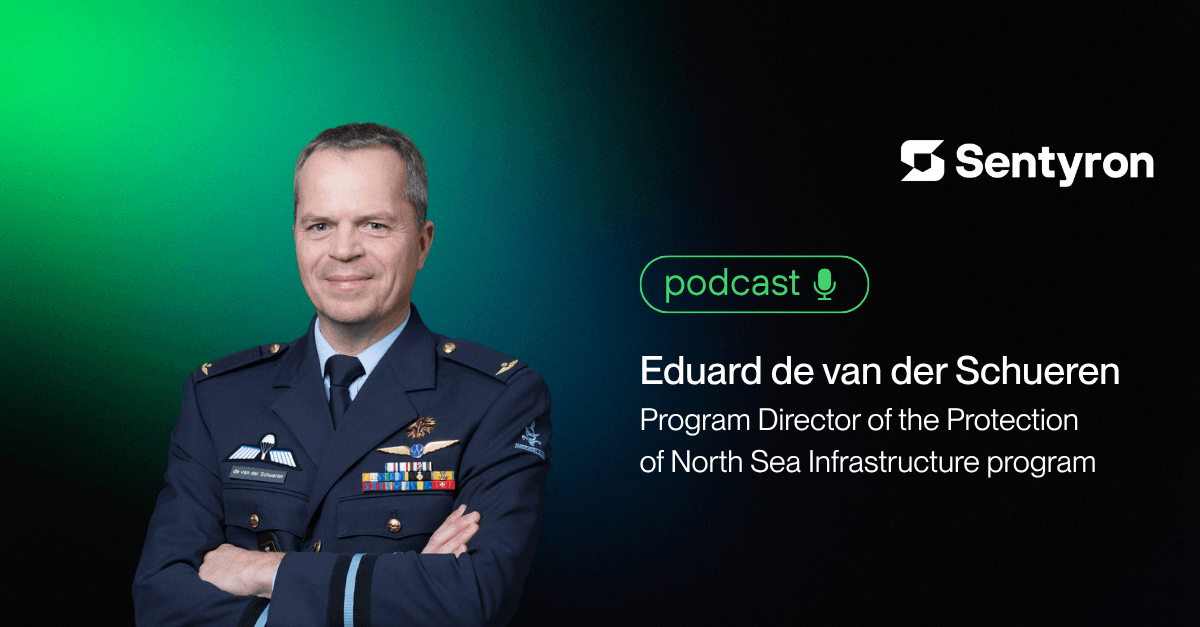
In the latest episode of The Sentyron Standard, host Willemijn Rodenburg sits down with Commodore Eduard de van der Schueren, Program Director for the Protection of North Sea Infrastructure. What this episode brings out is something specific: how the Netherlands and Europe need to change the way they think, decide and cooperate if protection is going to keep up with the threat. The protection of critical infrastructure, in Eduard's view, is no longer a technical or operational problem; it’s a question of mindset.
The instinct to wait is the instinct that loses
Eduard's most direct challenge to how Dutch institutions still work is also the simplest. Stop waiting for perfect.
"Eighty percent is also good. We can no longer afford ten or twenty years of development before a system is ready. At some point you have to say: good enough, we are going to work with this. Whether that is a system or a process."
He frames it explicitly as a cultural shift inside Defence: "What we see now within Defence is that risk tolerance is increasing. That does not mean we are becoming reckless, but we understand that you cannot eliminate every risk before you start something." The reference point he returns to is Ukraine. "If they had eliminated every risk first, to prevent a drone from falling on a residential area, they would have lost that drone war long ago. So they have made deliberate choices: we are not yet sure about this, it may not be perfect, but we are going to work with it."
The implication for the rest of government is harder. Within the Dutch public sector, accountability still has a strong tendency to push organisations towards caution, ministerial responsibility, and a careful balance between budget pressure and visible risk. Eduard is honest about that: "Taking responsibility within the government often means accepting ministerial accountability. There is always a risk attached to that, and it also often means co-financing. So when you ask who is responsible for this, you do not get a clear answer. Everyone looks at each other and hopes someone else says: I feel responsible."
The pattern is recognisable in many critical infrastructure conversations. The threat moves quickly. The decision-making moves slowly. And the gap between the two is widening. Eighty percent, in Eduard's view, is not a compromise. It is a survival strategy.
The cooperation problem is not goodwill. It is the wrong starting point
If risk tolerance is one shift, the way government works with industry is the other. Eduard sees genuine willingness across the sector to contribute to the protection of the North Sea. Operators, fisheries, pilots, telecom providers, technology firms. The will is there, but the model is not.
His critique of how the technology industry usually shows up is sharp: "Companies used to develop something and say: buy this, and your problem is solved. And we said, but that was not my problem. I need something completely different." The conventional pattern, in other words, is supply-led. A vendor brings a product to the table and looks for the problem it fits. Eduard wants to turn that around. The problem has to come first, defined jointly between government and sector, before anyone starts thinking about what the answer looks like. He points to environments where that joint problem definition is already happening. SeaSEC, the Seabed Security Experimentation Centre in Scheveningen. FLECS, Field Lab Energy-systems Cyber Security, focused on innovation for digital protection. Similar institutes exist abroad. Their common pattern is shared R&D logic rather than procurement logic. The frustration that runs underneath this is simple:
"Many companies see this primarily as a business model for their own organisation. I keep saying: you are not just contributing to national security, you are part of national security. That business model has to step aside occasionally."
Eduard does not expect companies to work for free. He does expect them to recognise that they are inside the system they are trying to sell into. That recognition, he believes, is what separates real partners from short-term suppliers.
Information sharing is asymmetrical, and pretending otherwise breaks trust
The same logic applies to the exchange of information between the government and operators. The program needs detailed data from companies: where cables run, how they are built, what is happening inside them, where the weak points sit. Companies are willing to share more than they used to. But they expect something in return. Threat intelligence, context, and an honest sense of how exposed they really are.
That is where Eduard runs into a structural limit: "How vulnerable are we as the Netherlands? That is often information you do not want to share with everyone, because you do not know exactly where it ends up next. And that makes it a challenge for us to ask for a lot, but not always be able to give everything back. Some companies do not find that easy. They would like to get everything back." He understands the position. He also will not pretend the asymmetry is going away. What changes is how the relationship is framed. Companies that treat this as a transaction will be disappointed. Companies that treat it as a partnership in national security will get further, even when not every piece of intelligence flows both ways.
What Scandinavia got right about national security
Eduard wants The Netherlands to embrace what the Scandinavian countries built decades ago: total defence.
"Total defence goes much further than people often think. It is not just being a reservist or having served in the military once. It is collectively understanding that we have to contribute to that security together."
The practical effect would be a different default question. Not "who is responsible for this?" but "what is my part in this?" That changes the dynamic between government and sector. It changes the way budgets are framed. It changes what citizens, companies and institutions are willing to accept as their own role.
Eduard does not romanticise it. He is clear that total defence has a precondition. "It requires that you continue to like each other, so to speak. The moment one country moves in a different direction, that whole house of cards collapses." In a Europe facing political fragmentation, populist swings and shifting alliances, that is not a small condition. But it is also why he believes the work has to start now, while the conditions still hold.
"If we had embraced this concept seventy years ago, the way the Scandinavian countries did, we would already be much further along." That is a polite way of saying the Netherlands is late. And catching up requires more than a program, it requires a posture.
Listen to Eduard's podcast (in Dutch) via Spotify or watch the podcast on YouTube.