
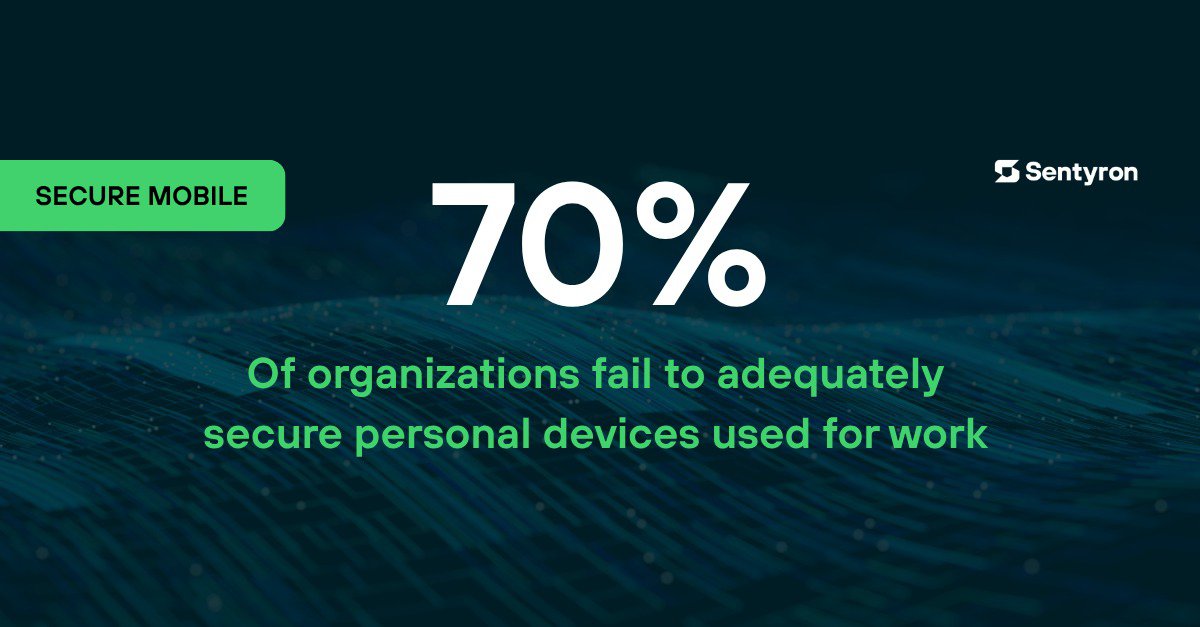
Most organizations approach mobile security the wrong way. They start with the device; which model, which operating system, which MDM platform, and work backwards from there. The result is a patchwork of controls layered onto consumer hardware that was never designed for the threat environment it is operating in.
The right starting point is not the device, it’s the question: what does this device need to protect, against whom, and under what conditions? The answer to that question determines the architecture, and the architecture determines the device.This shift in framing is the difference between mobile security as a product decision and mobile security as a strategic one.
Why reactive security no longer works
The threat environment has changed faster than most security strategies have adapted. Zero-click exploits compromise fully updated devices without any user interaction. Deepfake phishing attacks have become increasingly difficult to distinguish from legitimate communications. State-sponsored actors target the personal devices of employees specifically because those devices sit outside the security perimeter organizations have invested in protecting.
Standard controls; MDM, antivirus, and awareness training, address known attack patterns on devices that were not built for high-assurance environments. They are necessary, but unfortunately they’re not sufficient. The gap between what these controls provide and what sophisticated adversaries can do is widening, and organizations that have not acknowledged that gap are carrying an unquantified risk.
Four philosophies, four levels of assurance
Mobile security is not a single decision. Different organizations face different threats, and different roles within the same organization carry different risks. What this means in practice is that there is no one-size-fits-all solution; there is a spectrum, ranging from basic messaging security to hardware-level protection for the most sensitive environments.
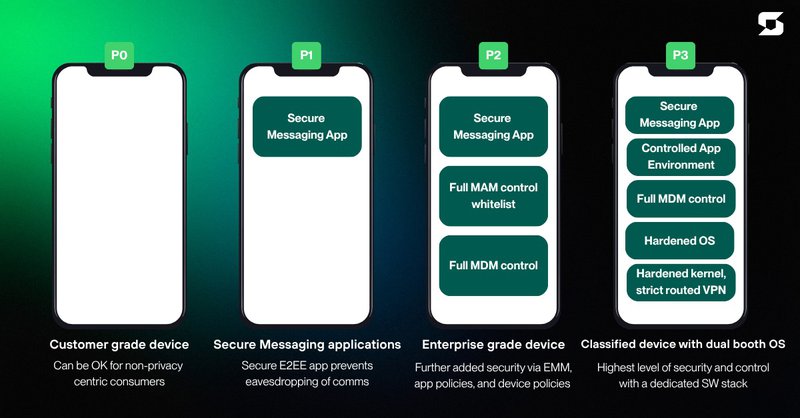
- The first level is a consumer-grade device with a secure messaging application installed. End-to-end encryption prevents eavesdropping on communications, but the underlying device, operating system, and application environment are uncontrolled. This is adequate for low-sensitivity personal use, but It’s not adequate for organizational communication involving sensitive data.
- The second level adds enterprise device management: an MDM or EMM platform that enforces configuration policies, manages application access, and integrates with corporate identity infrastructure. This addresses the configuration and policy problem, because the device is now managed but it’s not hardened yet.
- The third level is a full-stack controlled architecture at the Restricted classification level. This means a hardened operating system, a strictly routed always-on VPN, and full device management; all running on certified hardware. The security properties of the device are determined not just by software policies but by the architecture of the stack itself. This is the level required for organizations handling genuinely sensitive information under NIS2, EU Restricted, or equivalent frameworks.
- The fourth level adds hardware-based security and dual-OS architecture for Confidential-level classification. Classified and enterprise environments are separated at the hardware level, with verified boot, and cryptographic assurance at every layer. This is the architecture for defence, national security, and executive-level protection against targeted state-sponsored threats.
Zero Trust is not a product. It is a principle.
Across all four levels, the underlying principle is the same: no device, user, or network connection should be trusted by default. Zero Trust applied to mobile means continuous verification of device integrity, user identity, and network context before access to any resource is granted. It means that a device connecting from an unrecognized network is treated differently from one connecting from a known environment, and that the policy enforcing this is technical, not procedural.
This matters because the perimeter has ceased to exist in any meaningful sense. A device that accesses corporate systems from a hotel in Brussels is in the same security posture as one connecting from a coworking spot in Amsterdam. The access controls need to reflect that reality.
What this looks like in practice
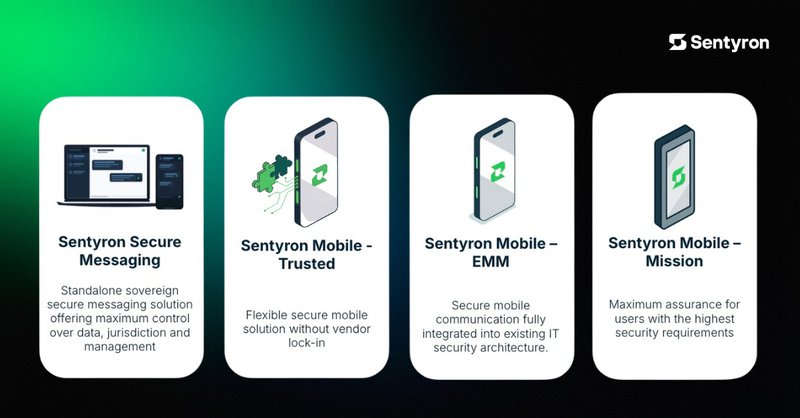
Sentyron's Secure Mobile portfolio is built around this architecture-first approach. Rather than offering a single device or platform, it provides four solutions mapped to the four levels of assurance described above: Secure Messaging for organizations that need sovereign encrypted communication without replacing their device fleet; Mobile Trusted for certified secure communication on familiar Android hardware without vendor lock-in; Mobile EMM for organizations that need certified mobile security fully integrated into existing enterprise infrastructure; and Mobile Mission for the highest confidentiality requirements, with hardware-enforced domain separation on purpose-built devices.
The right solution depends on what you are protecting, who you are protecting it from, and what operational constraints your organization works within. Those questions come before any product discussion.
The maturity question
Most organizations sit somewhere between level one and level two on the spectrum described above. Many have not yet deployed MDM consistently across their entire device fleet, and some have no mobile security architecture at all.
The path forward does not require jumping immediately to the highest level of assurance. It requires an honest assessment of where you are, what the realistic threat to your organization looks like, and what the next concrete step is. For most organizations, that step is establishing a managed baseline: device management, endpoint protection, and enforced encryption across all business devices.
From that foundation, the architecture can be built upward toward the level of assurance that the threat environment and regulatory framework actually require. NIS2 has made that framework explicit. The eighteen critical sectors now in scope have a compliance obligation to address mobile communication tools. The organizations that treat that obligation as a driver for genuine architectural improvement rather than a checkbox exercise will be the ones that are actually secure.